Showing posts with label Wildlife. Show all posts

September 17, 2013

Yellowstone 2013 Visit—#6


While we were eating our lunch in a small park, this mother deer and fawn moved through the eating area.  Both of them watched us for some time from the safety of the woods; but then, mom decided that we were not too much danger so they moved through the area. 
Even though only the fawn’s head is in the photo, this is my favorite image that I took because of how both mom and baby are looking straight at me. 
Enjoy. 
Camera settings:  Nikon D4 on a tripod, 80-400mm f/2.8 at 350mm, ISO 280, f/5.6 at 1/7500th of a second. 
Post Processing: 
Lightroom 5—applied Nikon Standard preset, set white and black points, added vibrance and clarity.

September 6, 2013

Yellowstone 2013 Visit—#4


There are about 2,000,000 acres in Yellowstone National Park, yet, the only place this guy found to walk was down the middle of the road.  Go figure! 
Enjoy. 
Camera settings:  Nikon D4, 80-400mm f/3.5~5.6 at 400mm, ISO 400, f/5.6 at 1/180th of a second (supported by hood of auto). 
Post Processing: 
Lightroom 5—applied Nikon Standard preset, set white and black points, added clarity, sharpness and vibrance and did some dodging and burning.

August 14, 2013

Yellowstone—Revisited #4


We were hiking one day when we came across this deer.  We decided to take a break, ate a snack and sat and watched her for some time.  When we got to leave, she started following us.  I cannot say how far she followed us, but it was at least 20 minutes. 
Just liked how she looks so natural in the woods. 
Enjoy. 
Camera settings:  Nikon D200, 70-200mm f/2.8 at 90mm, ISO 400, f/8 at 1/90th of a second on a tripod 
Post Processing: 
Lightroom 5—applied Nikon Standard preset, set white and black points, added clarity, sharpness and vibrance.

August 2, 2013

Yellowstone—Revisited #2


Recently, Bill, a friend and fellow photographer, asked me about how I decide what to shoot.  I told him that you must think about your photos as a visual story.  You may have one photo to tell the story or a series of photos to tell the story.  Either way, you must shoot what helps you tell that story—which, of course, will vary from story to story. 
Today’s photo is part of the Yellowstone story—traffic jam, Yellowstone style.  As a photograph, this photo is nothing special, but as part of a larger package (think, Yellowstone vacation book or slideshow), it helps tell something about what I experienced in Yellowstone.  Something that is unique to Yellowstone. 
Enjoy. 
Camera settings:  Nikon D200, 24-70mm f/2.8 at 24mm, ISO 200, f/8 at 1/90th of a second. 
Post Processing: 
Lightroom 5—applied Nikon Standard preset, set white and black points, added clarity, sharpness and vibrance, cropped into panorama and burned top and bottom of photo using the adjustment brush.

July 23, 2013

Brazos Bend State Park and Alligators


You cannot go to Brazos Bend State Park and not come back with a few photos of alligators.  In reality, alligators are not really that exciting to photograph.  Still, I always photograph them when I am at the park. 
This young male alligator was lifting his head out of the water and roaring.  He was in a vocal war with an older and much larger alligator. I wanted to capture him coming out of water and doing “his thing”, but I also wanted to create a little mood to the photo.  Luckily, he swam from the shade to a pocket of light. So, I waited until he got to the light and took about ten shots of him in the light. 
To me, this photograph is as much about the light as it is about the alligator.
Enjoy. 
Camera settings:  Nikon D800 (DX format), 80-400mm f/4.5~5.6 at 600mm (effectively), ISO 400, f/8 at 1/350th of a second on a tripod. 
Post Processing: 
Lightroom 5—applied Nikon Vivid preset during import, set white and black points, added clarity, sharpness and vibrance and burned top and bottom of photo using the adjustment brush.

October 22, 2010

Bird Photography by a Non-Bird Photographer 101—Lesson 1


Why would a non-bird photographer give a bird photography class.  Good question.  I do not think I have reached my federally approved level of humiliation this week.
I know what you are asking:  “What disqualifies you from being a bird photographer?”
1.  I take bad bird photos.
2.  I do not have the patience to take good bird photos.
3. I do not know what I am doing when a bird is in front of my lens.
4. I do not have the equipment to be a “real” bird photographer—in general, “real” bird photographers must have a lens that allows you to see ants on the moon.
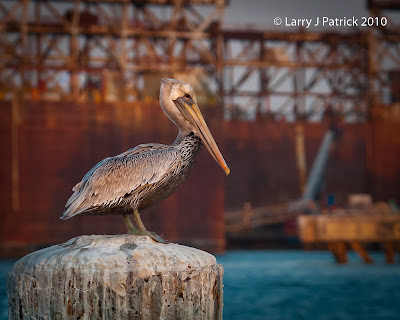
I know your next question:  “Why are you doing this?”  I lost a bet?  Really, it all started when I was down in Galveston after a portrait session and I remembered that “birds of a feather” was our club’s assignment for October.  So, with my mighty 70-300mm lens in hand, I set-out to capture the perfect bird photo.
Here I wanted to play with the compression created by my massive 300mm of thundering glass.  The bird was about 100 feet from me and the rigs in the background were about 600 yards.  Yet, because of the compression, the two look like they are right next to each other.  I think this effect adds interest to the photo.
The image that is shown here only represents about 40% of the frame that I captured—a nice 600mm lens would have made the photo to be pretty much full frame and think about the compression and bokeh that I could have achieved.   And just think, I could achieve this by merely forking over $10,300 for a Nikon 600 AF-S f/4G VR.  Cheap at twice the price.  I wonder how fast B&H can get it to me?
Enjoy.
Camera settings:  Nikon D3, Nikon 70-300mm f/3.5-5.6 at shot at 300mm ISO 200, f/5.6 and 1/750th of a second.
Post Processing:  
Lightroom 3—Set black and white points, added clarity and mid-tone contrast.
Photoshop CS5—removed a few distracting elements within the photo and balanced the colors within the image.

June 4, 2010

Along a Trial

One of the great things about hiking in national parks is seeing things that you do not normally see in your day-to-day life.  JD and I was about half way through our hike when we wondered upon three mountain goats.  Normally, mountain goats are very shy and take-off the moment that they see you, however, these three stayed around for about twenty minutes while we ate a snack and watched them.
In this photo, I like the way the white of the mountain goat contrasted against the dark bark of the trees.
Enjoy.
Camera settings:  Nikon D3, Nikon 70-300mm f/4.5-5.6 at ISO 800, f/9.5 and 1/500th of a second on a tripod.
Post Processing:  
Lightroom—Set black and white points, and added clarity and vibrance.

September 16, 2009

Doe at Dawn

A friend of mine has a small ranch a little south of Alvin, Texas. The ranch has an old windmill that is quite striking at sunrise. I got up long before the sun and headed down to his ranch to get the shot. The windmill is about a half-mile walk from his house. So, there I was walking along a small path in the dark. I was determined to get my windmill shot.

What did I get? Totally overcast skies that provide zero amount of sunrise.

As I was walking back to his house (looking forward to the big, country breakfast that he always fixes), I saw about six deer on the edge of the tree line. I moved closer and set-up my tripod and waited for the deer to move closer. They cooperated. I got several good shots, but this one was my favorite—mainly because of the way the soft, dark background sets the doe off.

Enjoy.

Camera settings: Nikon D3, Nikon 70-200mm f/2.8 at 200mm, shot at ISO 200, f/2.8 and 1/6,000th of a second.

Post Processing:

Lightroom—Set white and black points, added mid-tone contrast, clarity.

Photoshop—used nik Color Efext Pro tonal contrast filter on the doe to increase contrast of highlights, mid-tones and shadows.

June 5, 2009

Brazos Bend State Park #9--REVISED!

This morning, I was working on some portraits that I took yesterday, and for some reason, I decided to look at my blog.  Now, as I have stated before, I normally do not read the comments that have been posed on my photographs until the weekend--I feel this is a substitute for a leisure read of the Sunday paper.  I know that this infuriates some of the people who comment on my work, but that's just the way I do things.   Sorry.

Well, both Wayne and DHaass had the same comment on today's photo of a dragonfly, i.e., the curved branch below the dragonfly was very distracting and took your attention off the main subject.    I respect both of their opinions, even if I do not always agree with them (for everyone's information, I only agree with one person's opinion a 100% of the time--Janice D. Patrick's!)

As all of you know, I like things simple.  So, I studied the photograph for a while and decided that they were absolutely right.   I know present my new and improved version of the dragonfly for only an additional . . .

Enjoy.

May 29, 2009

Brazos Bend State Park #4

Sometimes it is better to be lucky than good.  

This photo is a testimonial to that.  I was trying to take a photo of these two ducks who were in a heavily wooded area.  No matter what I did, I could not get a clear shot of them.  When I moved a few branches, it startled the ducks and off they flew.  But to my amazement, I turned and saw the two ducks landing on a stump that was about 80 feet from me.  I had a completely unobstructed view of them and a great background to boot!  I did not move my tripod, I merely turned my camera around and started firing.  I felt like Moose Peterson--I was firing away at like 1,000 frames per second!

I really like the earth tones in this scene and how the ducks are clearly separated from the background.   The background was far enough away so that even at f/9.5 (which made sure the ducks would be totally in focus), I got a very nice out-of-focus background.

Enjoy.

Camera settings:  Nikon D700, 300mm f/4 with 1.7x Nikon Teleconverter and polarizing filter attached, shot at ISO 200, f/9.5 and 1/90th of a second on a tripod.

Post Processing:

Lightroom—Set white and black points, added mid-tone contrast. Increased color saturation and hue for yellow and green.

Photoshop—used nik Color Efex Pro tonal contrast filter to add contrast to highlights, mid-tones and shallows, and added a boarder to the image and added boarder using a stroke and various layer style options. 

May 27, 2009

Brazos Bend State Park #2

The contrast of colors was what drew me to this scene.  The greens and browns of the background and water versus the blues and reds of the bird is what makes this photo for me.  For some reason, when I posted the image and then previewed it, the browns have a slightly greener cast than my original RAW file, so try to image it without that cast.

I put my tripod as low as it would go (I was laying on my belly--constantly watching for alligators) so that I would be shooting straight-on at the bird’s eye—I wanted to make sure I would capture any catch-light in the bird’s eyes.  I then yelled "action" and this little guy started swimming straight at me.  It is great to work with "first rate" talent like this guy!

Enjoy.

Camera settings:  Nikon D700, 300mm f/4 with 1.7x Nikon Teleconverter and polarizing filter attached, shot at ISO 200, f/16 and 1/60th of a second on a tripod.


Post Processing:

Lightroom—Set white and black points, added mid-tone contrast and darkened brown and greens in scene.

Photoshop—cloned-out blown-out highlights and used nik Color Efex Pro tonal contrast filter only on the bird to bring out as much detail as possible in his feathers.