Showing posts with label Houston Zoo. Show all posts

May 22, 2012

Nikon D4—What’s with It?


At 4:17 PM on April 30, 2012, my UPS man delivered a package that I have been expecting for over three months.  Yet, no D4 photos have appeared on my blog.  What’s with that?
Well, the two of us have been getting to know each other.  Sound a little crazy.  Yep, that’s what my bride (of 45 years) thinks.  But, let me explain.
The first thing that I did (now hold your breathe) was read the manual.  I then started setting-up it the way that I thought would best fit my way of shooting.  Many people have said that the D4 is an evolution from the D3—well, that may be, but what an evolution.
So many of the D4’s controls have bee refined from the D3.  The D4 is much easier to shoot with because some critical controls have been moved from being buried within the menus to buttons on the camera.  To change image size, picture controls and autofocus mode and area-mode on the D4, you merely push a button.  No more searching menus.  Now this may not sound like much but all three of these controls were place in my menu on my D3 because I accessed them so often.
Enjoy.
Camera settings:  Nikon D4, 70-200mm f/2.8 at ISO 1600, f/5.6 at 1/350th of a second.
Post Processing:  
Lightroom 4—set white and black point and increased contrast.

March 13, 2009

Houston Zoo #15

This is one of the attendants at the merry-go-round.  He greeted everyone with this big smile.  As I watched him do his job, I saw how everyone seemed to perk-up a little as they met him.

My trip to the Houston Zoo produced a lot of fun, some stupid mistakes, a little learning and 15 shots that I posted on my blog.  Overall, I must say “a very successful outing.”

Thanks again, Bob.  Too bad you have raised the bar on what I expect from you in the future.  But, that’s life.

Enjoy.

Camera settings: Nikon D3, 70-200mm f/2.8 at 200mm, shot at ISO 200, f/4.8 and 1/250 of a second.

March 12, 2009

Houston Zoo #14

This lady was stalking me.  Everywhere I went, I would look-up and there she was.  I thought about calling the park police, but then again, you do not want to destroy a young girl's dreams.

OK, so I might be fantasying just a little.  OK, a whole bunch.

I had seen this young lady several times while walking around; and, although she is very pretty, what really struck me was how she always seemed to stand or sit in a very graceful way.  It was like someone was directing her during a photo session.

Enjoy.

Camera settings: Nikon D3, 70-200mm f/2.8 at 200mm, shot at ISO 400, f/5.6 and 1/250 of a second.

March 11, 2009

Houston Zoo #13

This is Emily.  She is a twin.  Her sister is hiding behind her father, peaking at me.  Her father is telling Emily that she cannot do something.  Do you think he made a sale?

Enjoy.

Camera settings: Nikon D3, 70-200mm f/2.8 at 200mm, shot at ISO 200, f/7.1 and 1/1000 of a second.

March 10, 2009

Houston Zoo #12


Meet “Crash”.  If you watched this little tyke for a few minutes, you would clearly understand why his parents have tagged him as “Crash.”  He is 100% boy.  He thinks his face is part of his landing equipment, especially when he has something, like pop corn in his hands. 

Enjoy.

Camera settings: Nikon D3, 70-200mm f/2.8 at 200mm, shot at ISO 200, f/8 and 1/250.

March 9, 2009

Houston Zoo #11


I was taking a photograph of some children playing when I felt this tap on my back.  I turned and there was Jolle.  She asked if I would take a picture of her and her mom for her dad.  I agreed.  Her mother told me that she was shocked that Jolle had asked since she is a very shy little girl.  After several shot of both of them, I zeroed in on Jolle.  This is my favorite because I think some of her shyness shows.

Enjoy.

Camera settings: Nikon D3, 70-200mm f/2.8 at 200mm, shot at ISO 200, f/8 and 1/250 of a second.

March 6, 2009

Houston Zoo #10


Two things struck me as I looked at this young girl—her expression and the lighting on her face.  I wanted to zero-in on her, and only her. I was somewhat conservative in my selection of f-stop since I do not shoot very often with this lens/telconverter combination, I was not sure what depth of field I would get.  Normally, I would have selected a f-stop that produced much shallower depth of field.

Enjoy.

Camera settings: Nikon D3, 300mm f/4 with 1.7x teleconverter attached (effective 500mm lens), shot at ISO 560, f/8 and 1/125 of a second on tripod.

March 5, 2009

Houston Zoo #9


As I was getting a drink, this black bird flew over and landed on the post about 15 feet from me.  I had just changed my lens to my Nikon 70-200mm f/2.8.  I wanted the photograph to show the blue/black of the bird against the bright, multi-colored background of flowers.   From where I was sitting, the bird’s tail was positioned where it was not framed by the colorful flowers.  I decided to take the shot as it was presented (which is this one) and then try to move my position so that all the bird's tail was framed by the flowers.   About the time I got repositioned Mr. Blackbird remembered he had an appointment and flew off.  So goes the live of a famous bird photographer.

Enjoy.

Camera settings: Nikon D3, 70-200mm f/2.8 at 200mm, shot at ISO 200, f/8 and 1/250.

PS--I checked today's posting and noted the background does not have any of rich, deep colors that the shot has (even when I hit preview posting at blogger).   Any ideas about this?

March 4, 2009

Houston Zoo #8

As I looked at this bird, I could not help but wonder why they stand on one leg.  It does not look comfortable.  I thought that the bottom portion of the body and the top part of the legs might make for an interesting perspective of this unusual practice.  I should have used a larger aperture so that the background would have a little more blurred.

Enjoy.

Camera settings: Nikon D3, 300mm f/4 with 1.7x teleconverter attached (effective 500mm lens), shot at ISO 200, f/11 and 1/90 of a second on tripod

March 3, 2009

Houston Zoo #7

As a noted bird photographer, I could not pass-up this photo opportunity.  This scene did not look like it was inside a zoo.  I underexposed my shot by about 1 EV and then adjusted the brightest part of the bird so that it was not quite pure white in Photoshop.

Enjoy.

Camera settings: Nikon D3, 300mm f/4 with 1.7x teleconverter attached (effective 500mm lens), shot at ISO 200, f/11 and 1/250 of a second on tripod.

March 2, 2009

Houston Zoo #6

To get this shot, I had to put my tripod on a bench and shoot over the fence.  I underexposed the photograph by about 1 EV because I wanted the colors to be very saturated.  I then put some light on the tiger’s face with a curves adjustment in Photoshop.

This is one of those shots that you wished you had a better background for the tiger--I just do no think they normally live on this type of grass!

Enjoy.

Camera settings: Nikon D3, 300mm f/4 with 1.7x teleconverter attached (effective 500mm lens), shot at ISO 200, f/8 and 1/125 of a second on tripod.

February 27, 2009

Houston Zoo #5

This monkey was sitting in the tree watching all the people walk by.  I could almost hear him thinking:  “If I evolve, do I have to wear that shirt with those pants.  I sure hope not!”

I really liked the monkey's pose and the clean background in front of him, but I had two problems:  there was a lot of “garbage” on the monkey's backside and the light was very hard on his front.  I decided on a slightly unconventional crop that did not show all of his body to solve the garbage issue and decided to underexpose the image by about 3 EV to make the photograph as much about the lighting as the subject.  I really did not care whether the fur on his front legs blew-out; I thought that would just help separate him from the background.

Enjoy.

Camera settings: Nikon D3, 300mm f/4 with 1.7x teleconverter attached (effective 500mm lens), shot at ISO 200, f/13 and 1/750 of a second on tripod.

February 26, 2009

Houston Zoo #4

I watched “Mystery Animal #3” for some time.  He was totally engrossed in eating his lettuce, but he was so far into the shadows of the trees that I could not get a good shot of him.  

After a while, another “Mystery Animal #3” came close to him and he moved into the light where I got this shot.   When he moved into the light, the lettuce became a very bright green which significantly took away from his eyes. I wanted his eyes to be emphasize in the final image, so,  I used selective color and saturation (green) layers in Photoshop to lower the brightness and color saturation of the lattice.  I thought about reducing the light on his tail, but then elected to leave it as it was recorded.  I believe the image looks like this little guy is out in the wild rather than in a zoo.

Enjoy.

Camera settings: Nikon D3, 300mm f/4 with 1.7x teleconverter attached (effective 500mm lens), shot at ISO 400, f/13 and 1/60 of a second on tripod.

February 25, 2009

Houston Zoo #3

I have seen some interesting photographs of “Mystery Animal #2.”  The photos are usually straight on, and showed his painted face—that is the shot that I wanted; but, this guy was behind a wire fence.  Shooting through the fence, I kept getting lots of lines in my shot.  Finally, I noticed a small brake in the fence that I could focus through.  This guy kept walking back and forth in front of the hole, but never looked straight at me.  I changed my plan and tried to get a profile shot of him with the light hitting his back.   I pre-focused on his position when he was in the opening and the started firing away at full speed while he walked from one side of the hole to the other.  I cropped-out the lines of the fence on all sides and selectively added some light to his face in Photoshop.

Enjoy.

Camera settings:  Nikon D3, 300mm f/4 with 1.7x teleconverter attached (effective 500mm lens), shot at ISO 400, f/13 and 1/125 of a second on tripod.

February 24, 2009

Houston Zoo #2


Thank you, Barry for telling me that the animals I posted yesterday are Meerkats--my lovely bride of 40+ years had already told me, as my six year old grandson also did.  JD and Cole have informed me of the names of all the animals that I forgot to shoot the signs of; but, I do not plan on using the names so I can demonstrate how "stupid" I was (some would say "am" would be a more appropriate verb) in not photographing the signs.  So, get ready for more "mystery animal #s".

The male lion wondered over next to the Plexiglas near where I was standing.  Looking at him, I wanted the photograph to be totally about his face, especially his eyes.  My Nikon 300mm would only let me focus at a distance where I could get his entire face.   I thought about cropping the image after I got it into the computer, but then decided that I wanted to show the total frame.  This image has not been cropped.  You are seeing everything that I recorded.  

The major problem in taking this shot was making sure that I did not get any distortion or reflection from the Plexiglas.   I wanted the shot to be straight-on so that his eyes would be the main aspect of the photograph, but I got too much reflection, so I shifted my angle slightly in order to eliminate as much of the reflection as possible.   I still got some reflection in the very top left corner which I cloned-out in Photoshop.  A polarizing filter might have been the answer, but I did not have one with me.

Enjoy.

Camera settings:  Nikon D3, 300mm f/4 with 1.7x teleconverter attached (effective 500mm lens), shot at ISO 600, f/11 and 1/60 of a second on tripod.

February 23, 2009

Houston Zoo #1

On Saturday, the Bay Area Photo Club had its first field trip for 2009.  I must admit, I am not the best at attending our club’s field trips.  No excuse.  I just have not made many of them over the past year.  I usually have a good time at the field trips—not so much for the photographing, but more for the talking to my fellow members.

Before I go on, let me give Bob Dempsey a big “thank you.”  He did a great job finding this outing at the Houston Zoo, and the fact that he, personally, made the rain stay away from Houston until late in the afternoon, well, you cannot say enough about this level of commitment to his fellow club members. 

Great job, Bob.  Now, what are you going to do for us next month?

When I first saw Bob’s email regarding the field trip, I really was not interested in going to the Houston Zoo because I regularly venture over to the zoo with my two grandchildren.  But, then I started thinking (I know a dangerous thing for me) that I do not take many photographs of the zoo because of the two little ones. 

So, I decided to go.  I then asked myself, “Self, what do you want to get from this outing?”  I thought aboutit for a while and then decided that I wanted ten shots for my blog:  three of the animals, three of birds, three of people and one whatever.  I thought that this would be a pretty high goal, but I wanted to push myself.   

I thought that I should pack light since I would be doing a lot of walking,  I narrowed my equipment down to:  Nikon D3, Nikon 70-200mm f/2.8, Nikon 300mm f/2.8, Nikon 1.7 Teleconverter, Nikon 105mm f/2.8 Macro, two Nikon SB800 Speedlights, and tripod.  Almost all of my animal and bird shots were taken with the Nikon 300mm with 1.7 teleconverter attached while almost all of my people shots were taken with the Nikon 70-200mm.  I never used the speedlights or the Nikon 105mm macro lens.

I limited my post processing to my usual global changes in Lightroom (setting white and black points, adding clarity, vibrance and mid-tone contrast) and in Photoshop, to some “clean-up” (or as Cindi calls it “gardening”), adding a black stroke around the edge, cropping the image, local sharpening of main subject and some local exposure adjustments.   I would estimate that I spent less than 10 to 15 minutes on post processing of each photograph in the series that you will be seeing.

I plan to limit the technical information and the back story on each of the photographs.  I want this series to be about what kind of photographs you can produce from a visit to the Houston Zoo.  I want to challenge my fellow Bay Area Photo Club members to tell me how I could have taken a better shot.  (Legal notice:  I reserve the right to delete all comments that tell me to sell my camera and take-up knitting.)

I want everyone to understand a few mistakes I made along the way.  First, I forgot to photograph the sign of the various animals.  I am not that good with the names of these wonderful creatures.  So, some of the photographs will include “mystery animal #”.  This is such a stupid mistake.  I usually photograph signs to help me remember things like this because I think it adds to the overall effect of the image if you have these details in your description and once you have then it is easy to add them to your keywords  in Lightroom.   Second, I did not always get the name of the people I photographed.  Finally, I did not “try” enough different things.  I did not experiment much.  Photographing many of the animals takes some effort because of the barriers that the zoo has to keep the animals in their cages or possibly keep the animals out of the cage (depending on your viewpoint).  I did not try shooting through many of these barriers.  In hindsight, I think I might have gotten something that is a little different if I had tried this more.

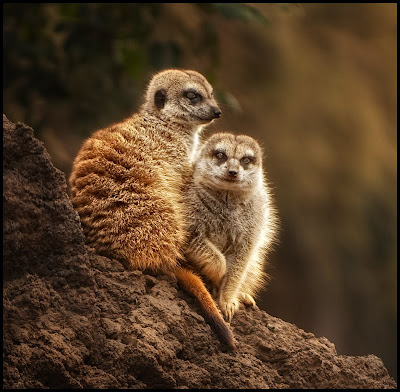
Today’s image is not really about the two “mystery animals #1s” but rather about the light.  It was taken early in the morning.   I wanted the soft light and the backlighting to be highlighted.

Enjoy.

Camera settings:  Nikon D3, 70-200 f/2.8 at 200mm, shot at ISO 800, f/4 and 1/180 of a second with on a tripod.