Showing posts with label Action. Show all posts

June 26, 2012

Casey—Doctor, Competitive Swimmer and Nice Lady


Meet Casey.  She is a medical doctor that swam competitively in college.  In addition, she is a really nice person.  But, I hope I never see her professionally—no offense, Casey.
Here, I was trying to be a Sports Illustrated photographer—I really had no idea how hard it was to time the shot, even at 1/6000th of a second.  At the end of the shoot, I had lots of shots with nothing but water!  I guess this proves that every time you pick up the camera, something will be different.
Enjoy.
Camera settings:  Nikon D4, 70-200mm f/2.8, ISO 400, f/3.3 at 1/6000th of a second.
Post Processing:  
Lightroom 4—set white and black point and increased contrast, increased clarity, contrast and sharpness around Casey with the adjustment brush.

May 1, 2012

Taylor #1


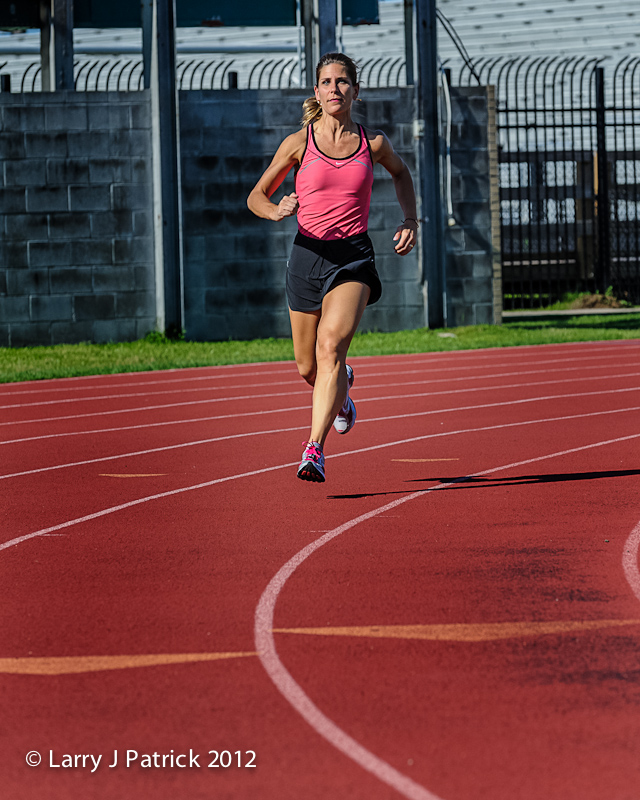
Meet Taylor—M.D., PhD., marathon runner and really nice lady.  I am sure there any many more things that you could say about here, but I think you get the idea—she is an accomplished young lady.
My buddy, Steve, and I had the pleasure of photographing her about a week ago.  Taylor’s only request was for us to get a good photograph of her running.  According to Taylor, a good photograph would be one in which both her feet were off the ground and she did not look like she was dreading the next step.
Steve and I had a few problems getting her good running photo—hard light, messy background and, in my case, not too much sports photography talent.
I think this photo qualifies.  But, as always, what do you think.
Enjoy.
Camera settings:  Nikon D3 on a tripod, Nikon 70-200mm f/2.8 at ISO 800, f/5.6 at 1/3000th of a second.
Post Processing:  
Lightroom 4—increased clarity and vibrance and did some basic dodging and burning various parts of the photo.

November 24, 2009

How Do You Show Action with Just One Frame?

Yesterday’s post reminded me of this set of photos that I combined last year. At the time I was pondering how you might show action. To be honest, I was tired of using blur to show action and was looking for something different.

Here I combined four photos at varying opacity of a skateboarder to try to show the sequence of events that led to the skateboarder crashing and burning.

Enjoy.

Camera settings: Nikon D3, Nikon 70-200mm f/2.8 at 100mm with shot at ISO 200, f/4 and 1/1,000th of a second.

Post Processing:

Lightroom—Set white and black points, added mid-tone contrast.

Photoshop—combined four photos and used auto align feature and then mask off everything but the skateboarder and his skateboarder in each of the early layers and reduced the opacity of the early layers to 50%, 65% and 80%.

November 23, 2009

Getting Unstuck

I think that anyone who tries to produce something that might, on a good day, resemble art gets stuck, or as writers might label it, get writer’s block. I just might be getting photographer’s block!

Over the past six weeks, I have devoted most of my photographic energies to portraits and environmental portraits for hire. Although some of the engagements have had an element of “creativity” to them, most of have not been pushing the envelop. I wonder what someone like Joe McNally does to keep his creative juices flowing. At the McNally seminar that I attended a couple weeks ago, Joe indicated that he tried to “keep pushing at edge of his abilities.” That sounds great, but how do you do that when a client wants you to produce an acceptable product. I do not have an answer to that one.

I do know that when I get in one of these “funks” I will head over to someplace like Jamail Skate Park. Why? Because I do not consider myself a very good photographer of “action” and Jamail Skate Park is all about action.

I recently went by the park and decided to experiment with high-speed synch flash. After watching this young man for about 15 minutes, I introduced myself and told him what I wanted to do. He was game. I got one of his friends to be my VAL. I positioned my VAL to camera right and determined that I wanted to use a shutter speed of 1/1,000 of a second and a f-stop of 5.6. I felt that these setting would give me adequate depth of field and also stop the action. I placed my VAL about six feet from where the subject would be and set my Nikon SU-800 to fire my Nikon SB-800 at 1/4th power.

The photo is not really very special, but, it did push me in a direction that I normally don’t go, so I guess it is a successful photograph. But, I am not sure that all my play got me “unstuck.”

Enjoy.

Camera settings: Nikon D3, Nikon 70-200mm f/2.8 at 100mm with shot at ISO 200, f/5.6 and 1/1,000th of a second with a Nikon SB-800 in manual mode and set to 1/4th power at camera right and triggered using Nikon SU-800

Post Processing:

Lightroom—Set white and black points, added mid-tone contrast and cropped image/

Photoshop—used Topaz Adjust Pop present to bring out details within the image.

June 22, 2009

Shake It!

After a hard day at the ole doggie swimming pool, you need to shake it all off and head to the house.

Enjoy.

Camera settings: Nikon D700, Nikon 70-200mm f/2.8, shot at ISO 200, 200mm, f/5.6 and 1/4,000th of a seconds.

Post Processing in Lightroom—Set white and black points, added mid-tone contrast.

June 19, 2009

A Fine Belly Flop

I have never seen a dog be able to consistently produce the splash that this guy was able to do. This shot is all about the splash and his drive through the water. Because of his great performance, this guy earned the nickname "Big Splash."

Enjoy.

Camera settings: Nikon D700, Nikon 70-200mm f/2.8, shot at ISO 200, 200mm, f/5.6 and 1/4,000th of a seconds.

Post Processing in Lightroom—Set white and black points, added mid-tone contrast.

June 18, 2009

A Little Dog Action


A certain young lady and I ended up in one of our usual haunts last week. There was a lot of action, so that’s the theme of the next few shots. These shots are all about action—in case you could not tell, I tried to turn my D700 into a movie camera. With performances like this, this dog earned the nickname "Splash."

Enjoy.

Camera settings: Nikon D700, Nikon 70-200mm f/2.8, shot at ISO 200, 200mm, f/5.6 and 1/4,000th of a seconds.

Post Processing in Lightroom—Set white and black points, added mid-tone contrast.


May 5, 2009

You Don’t Have to Be Crazy, But It Helps

I have been doing a little “spring cleaning” on my photograph files—deleting some “not-up-to-current standards”, adding more metadata, etc.   I ran across this photo that I took a couple years back near Moab, Utah.  I was there with one of my life-long friends, Jeff.  At a local restaurant we learned of this place where a lot of the rock climbers go to practice various moves and techniques.  Our waitress told us “it’s a little climb” but you will get some good close-ups of the climbers.  The “little climb” was about 400 feet along a very narrow trail with an incline of 88.75 degrees (OK, it might have been a little less, but not much!).

Jeff and I met some really cool people, got some good photos and a complete understanding as to why being a little crazy helps if you are a rock climber. 

Enjoy.

Camera settings:  Nikon D200, 70-200mm f/2.8 at 200mm, shot at ISO 200, f/8 and 1/500th of a second.

Post Processing:

Lightroom—Set white and black points, added mid-tone contrast, clarity and vibrance.

Photoshop—used nik Color Efex Pro Tonal Contrast filter to add a little local contrast to highlights, mid-tones and shadows.

May 1, 2009

Dog Park and Miss. Chloe

West University Place has a wonderful dog park with an area for big dogs and one for small dogs.  My granddaughter, Chloe, loves to go to the dog park.  She loves dogs—all sizes and all shapes.  When the two of us go out for our day, we often end-up at the dog park.  She really likes to watch the big dogs chase sticks or whatever.  When a dog jumps into the pool, she laughs so hard, I often think she is going to split her clothes.

We watched this guy for probably an hour.  He truly loved his game of fetch—and he was quite good at it!

I wanted this photo to be all about him and his game of fetch.  By the way, according to Chloe ("Miss. Boss"), this is my best photo, even though she thinks that "he jumped higher" than my photo shows him jumping.   It is so nice having your own personal photo critic, especially a four-year-old one!

Enjoy.

Camera settings:  Nikon D700, 70-200mm f/2.8 at 120mm, shot at ISO 200, f/5.6 and 1/500th of a second.

Post Processing:

Lightroom—Set white and black points, added mid-tone contrast, clarity and vibrance.

February 18, 2009

Spring Training #2

Near the end of practice, I noticed that I had a wonderful sunset behind the boys as they did their final batting practice.  I set my camera to underexpose the ambient light by about 1.5 EV and then set my flashes to overexpose the subject by about 1.0 EV.  I wanted to saturate the colors of the sunset, but show all the details of the boys batting.  Again, I placed the two SB800s on each side of the batter at 45 decree angles, but this time, I replaced one of the boys with a dad (to avoid injury).  Again, my VALs did a great job.

Overall, I was really impressed with how the CLS worked.  In about 100 shots, I think I only had two or three flash failures.  After this little test, I will try some additional tests for the system.  Who knows, I might be selling my AlienBee triggers if I keep getting good results, because it really is easier to adjust the flash levels from the camera as opposed to adjusting them at the flash.

Enjoy.

Camera settings:  Nikon D700, 70-200 f/2.8 at 150mm, shot at ISO 800, f/8 and 1/180 of a second.

Post Processing: 

Lightroom—set white and black points, adjusted white balance and added clarity and vibrance.

Photoshop—did some clean of spectacular highlights on the boy's batting helmet.

February 17, 2009

Spring Training #1

After photographing "Mr. Red Whatever", JD and I headed to watch the big boys at spring training.  

I took various shots of their practice and then decided to use a little flash and try something different.  I usually carry two SB800s in my camera bag and since I recently watched the DVD of Nikon School presents A Hands-on Guide to Creative Lighting, I wanted to try-out some of the things that Joe McNally did in the DVD.  I used my Nikon D700’s built in commander as the control unit and two of the boys as my VALs.

This turned into a lot of fun both for me and the boys.  The boys would line-up to run through the drill and then line-up to be the VAL for the next boy doing the drill.   The boys followed my instructions to the “T”, except for the oohs and aahs that I got after each time the units flashed.  Being a VAL for a six year old boy is a real treat!

According to the history books, Ty Cobb sharpened his cleats before each game.  Looking at this young, budding-star, I think I see the same thing in him.   Look at that face.   Does that not look like the face of a person who will win at any cost?

I had one SB800 on each side of the boy sliding into home plate at a 45 decree angle.  I set my camera at   -1.0EV and the SB800’s were programmed to TTL mode at +0.3EV so that I would get a nice fill but not completely light-up the whole area.  I instructed the VALs to point the SB800s about 2 to 3 feet in front of the subject so that the light would be somewhat feathered.  To make it easy for them, I placed water bottles down on the ground where I wanted them to point the flashes.   My VALs did a great job!

Enjoy

Camera settings:  Nikon D700, 70-200 f/2.8 at 200mm, shot at ISO 800, f/8 and 1/125 of a second.

Post Processing: 

Lightroom—set white and black points, adjusted white balance and added clarity and vibrance.

Photoshop—used nik Color Efex Pro tonal contrast filter to add local contrast to the image except on the boy’s face and arms.

January 20, 2009

Houston Marathon #2

Today’s post is another from my trip to the Houston Marathon, but it will not include any technical data. Why?  Because of what I wrote yesterday on Brian Bastinelli’s blog.   As photographers, we too often think about this setting or that setting rather than our real purpose:  to make an image (it does not matter how we get there).

Today, we will have a little humor, a lesson from a outstanding image-maker and finally another attempt to get my abstract runners.


When you attend an event like the Houston Marathon, you must realize that there are some things that you will not have control over.  An example:  BIG HAIR.  Now, I am a Texas; I love Texas ladies; and, I like their BIG HAIR.  But, even big hair has it’s place.  Here I am having a little trouble with getting my shot around another viewer of the race.  Realize that you will be faced with situations like this and just deal with it.


Amy is 3½ years old.  She is a true artist.  She is the photographer that I aspire to be.  Here, she is photographing her mother and aunt.   She is constantly directing them—“a little closer”, “bigger smiles”, "keep your eyes open”, etc.   After each shot, she looks at the back of her camera to see what she has.  No fretting over camera setting, just total concentration on the results, and then the barking of new instructions to her models.  I did not see any of her images, but I bet her images captured the moment better than most of mine.


Finally, here is another attempt I made at capturing my abstract runners.  Enjoy.

January 19, 2009

Houston Marathon

Sunday, I went to the Houston Marathon.  I do not consider myself to be a very good sports photographer.  Why?  Because I do not take very many good sports photographs.   I must admit, it is not something that I really enjoy, so I do not do it very often.

So, why did I go to the Houston Marathon with my cameras in hand?  Well, I had an idea--I know this is risky for me!   I was over at a friend’s house a few weeks ago and I started looking at a couple of his Leroy Neiman paintings.  I really like the way the painter had abstracted the athlete and since I have decided to try more abstracts in 2009, I thought that would try abstracting some runners at the Houston Marathon.

My idea was to place my camera at street level, use a wide lens and a slow shutter speed.  I thought that I would get blurred runners and a sharp background (the buildings of the Houston skyline).  I did not get exactly what I thought, but I though a couple of them were interesting.  Here is one of my abstract runners.  Hope you enjoy.

Camera settings:  Nikon D700, 28-70 f/2.8 at 28mm, shot at ISO 1,600, f/8 and 1.5 a second with the camera resting on the street.

Post Processing:  Lightroom—set white and black point, and added mid-tone contrast, added clarity and vibrance, increased saturation of reds, yellows and blues, cropped the photo to be a more panoramic crop